2. Water molecules are attracted to other water molecules with
a much greater force than they are to oil molecules.
3. Water, which is polar, induces a dipole in oxygen. This permits
a dipole - induced dipole attraction allowing some oxygen to dissolve
in water.
4. Bromine (Br) has a larger size than does chlorine (Cl), large
enough for an induced dipole - induced dipole interaction to be
created. This interaction is strong enough to hold Br in a liquid
state.
8. They are all polar molecules, held together by dipole - dipole
interactions.
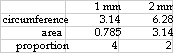
10. The proportion of water in contact with the tube compared to the surface area of the water within the tube decreases as the tube gets wider. Consider the following table:
12. Yes, we can talk about the surface tension of a solid, or
gas. The surface tension for a solid is much greater than that
of a liquid.
13. Decrease. As water is warmed the molecules move faster and
bonds begin to break, thus making it easier to break the surface.
17. One way is to try and dissolve more sugar, if it dissolves
the solution was not saturated. The other is to lower the temperature
of the solution, if crystals begin to form it was saturated.
18. The sodium nitrate will have a higher concentration (about
two times).
21. The chemical interactions between water and ethanol are such
that the molecules are brought closer together, hence taking up
less space. It is like mixing a bunch of marbles with a crate
of tennis balls, the marbles fill in some of the empty space between
the tennis balls.
1. concentration = (grams of solute/volume of solution). So, we need (15 L)*(3.0 g/L) = 45 g.